
ODOC Released Inmate Authority
The Oklahoma Department of Corrections operates the state correctional system, maintains offender and sentence records, processes releases from physical state custody, and administers probation and parole services. Its public lookup is called OK Offender Lookup. County sheriffs, jail trusts, and police departments remain the custodians of their own booking and release records. An ODOC search should not replace the county record when the person never entered state custody.
ODOC's policy on maintenance and access to offender records explains the source behind the public snapshot. Active files follow a person during jurisdiction. When jurisdiction terminates, files route toward Closed Records, and inactive records are maintained indefinitely subject to authorized schedules. That policy does not promise that each historical field or every discharged profile stays visible to the public for a fixed period.
The official ODOC home page confirms the agency name and branding.
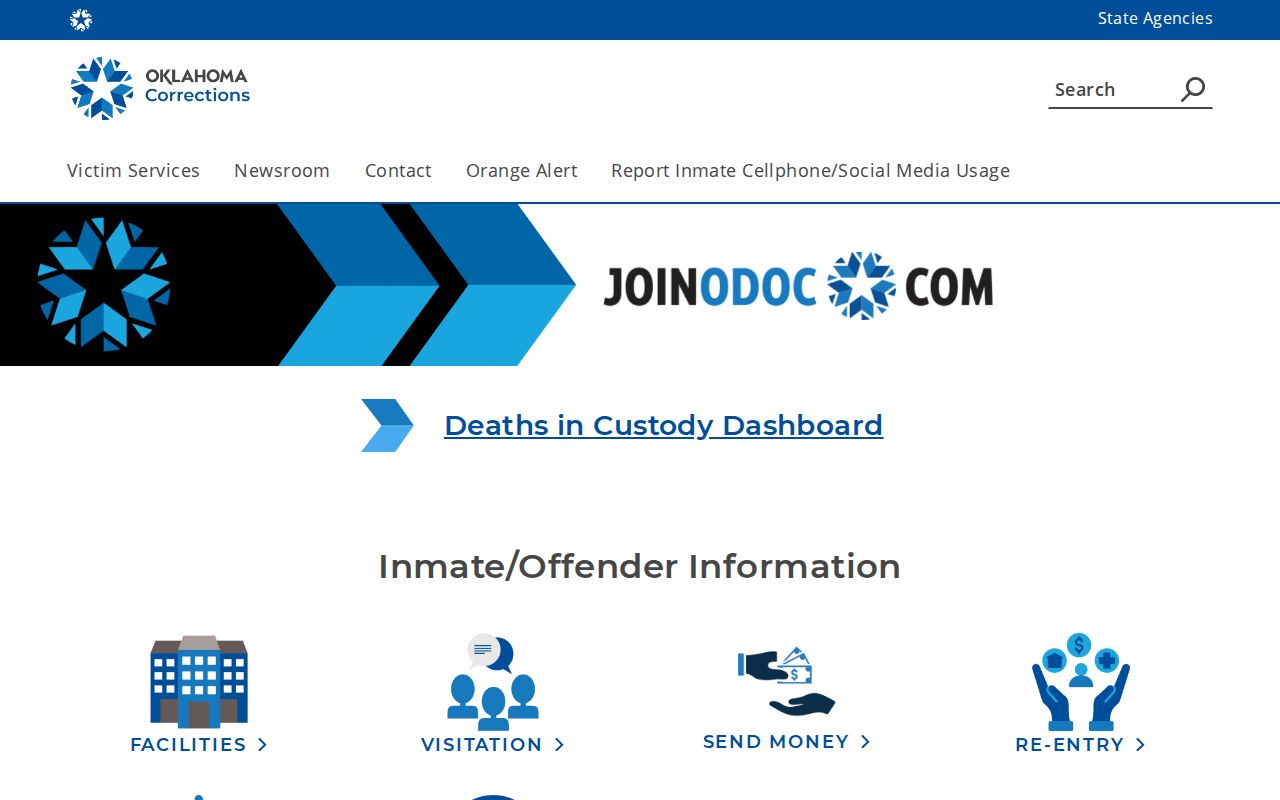
This statewide source should be separated from the 77 county release-record systems.
Use the ODOC Offender Search
Open the official search from ODOC Offender Info or go to OK Offender Lookup. Search by ODOC number when it is known because the number avoids many name collisions. A name search can also work. Open the likely profile and compare the photograph, age or other identifying detail, offense information, and agency number before relying on the status. A shared name is not enough.
The ODOC offender search presents its disclaimer and search inputs before any person record.
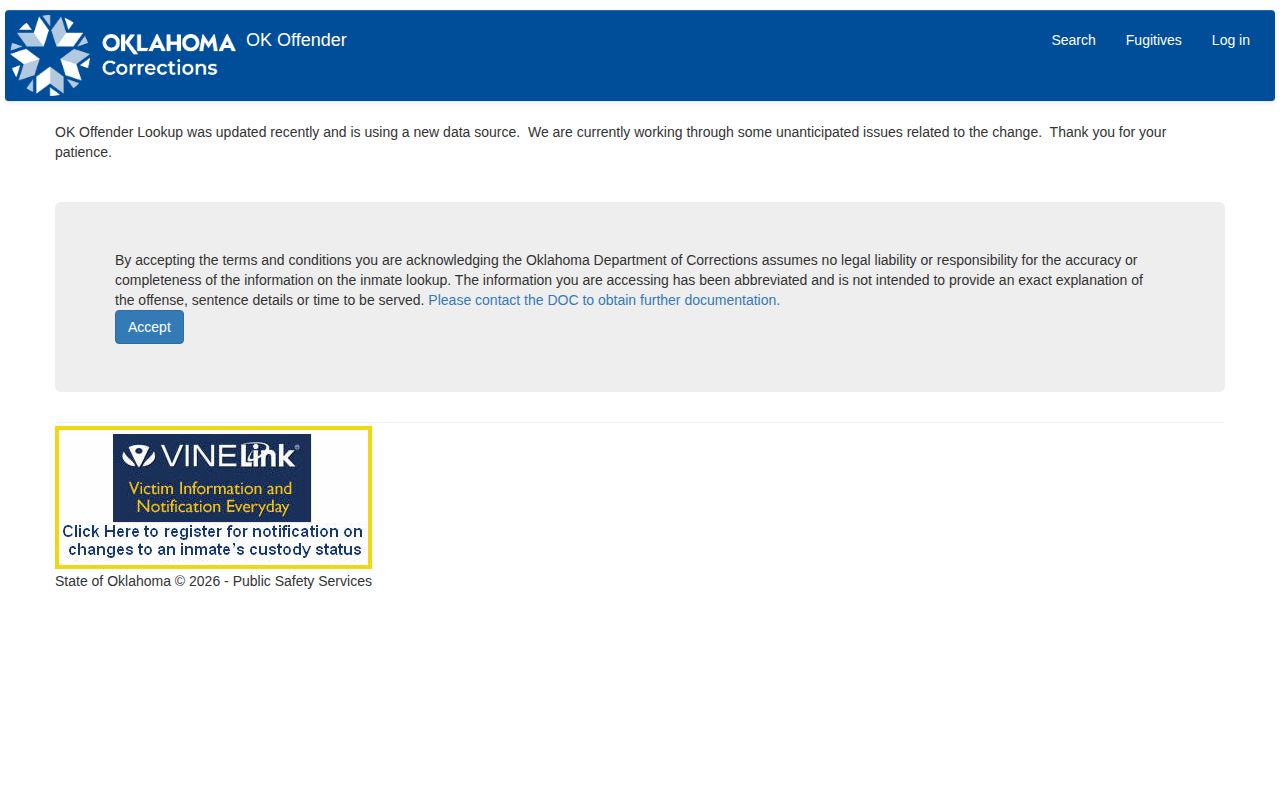
The disclaimer matters because public data can change and must be confirmed with the agency record when exact proof is needed.
- Enter the ODOC number, or use the person's exact name.
- Review all likely matches instead of choosing the first shared name.
- Confirm the photo, agency number, age details, offenses, and sentence context.
- Read the exact status and any supervision or historical fields that the profile actually displays.
- Save the access date, then request the named release document when the public profile is incomplete.
Important: A missing name is not proof of release because spelling, identity, public-field variation, and online retention can affect the result.
ODOC Released Record Fields
An ODOC profile may distinguish incarceration, community supervision, and discharge. The fields vary by person and status. Read the label the agency provides rather than forcing every record into one pattern. A projected release date concerns an anticipated prison exit. A supervision label can mean the person is outside prison but still within ODOC authority. Discharge generally concerns the end of jurisdiction for the sentence at issue.
The ODOC Offender Info source explains that projected values may appear while an exact future release date remains confidential absent a legitimate need.
A profile field records the current public value; it does not guarantee that the person will leave on that date.
| Field | How to read it |
|---|---|
| ODOC number | The durable agency identifier used to match profiles, dockets, and requests. |
| Photograph and identity details | Help distinguish people with similar names. |
| Offenses and sentence history | Provide state-case context but do not replace the certified court record. |
| Current status | May distinguish physical incarceration, community supervision, or discharge. |
| Projected release date | A tentative calculation where publicly displayed, not actual release proof. |
| Historical status data | May show prior stages, with content varying by record. |
| Facility or office | Identifies the current state institution or supervision routing when displayed. |
ODOC Release and Discharge
Oklahoma state records require four separate outcomes. Physical release means the person left a prison or other ODOC physical placement. Parole can end prison confinement while supervision and the sentence remain active. Community placement can move someone outside a secure prison without ending ODOC authority. Discharge generally marks the end of agency jurisdiction on the relevant sentence. The status field, sentence record, and formal document must be read together.
Credits also affect the path without changing those definitions. Under 57 O.S. section 138, earned-credit classes, exclusions, loss, and restoration depend on the controlling law and the person's record. Section 21 O.S. 13.1 establishes an 85-percent floor for an enumerated list of offenses. It does not apply to every felony. Parole eligibility, a projected release calculation, actual release, and final discharge remain different dates.
- Parole
- Release from prison to supervision before the full sentence ends.
- Discharge
- The recorded end of ODOC jurisdiction for the relevant sentence.
- Earned credit
- Statutory credit that can affect a sentence calculation subject to eligibility and conduct.
- Detainer
- A request or hold from another authority that may change the receiving custody path.
Sentence structure can make the public date hard to interpret. Concurrent sentences run together, while consecutive terms run one after another. Jail credit, achievement credit, misconduct, credit loss or restoration, later court orders, and other holds can alter the calculation. A parole-eligibility date may arrive before a projected discharge date, but neither establishes the actual physical release time.
When a projected date appears to have passed, confirm that it was copied correctly and note when it was viewed. Then check the current ODOC status and ask the agency about the lawful public record. Do not infer agency error, unlawful detention, or an unrecorded release from a stale screenshot.
ODOC Release Totals
The ODOC CY2025 Annual Progress Report records 5,662 releases from physical prison custody in calendar 2025, split between 4,790 male and 872 female releases. Its grand-total table reaches 5,807 when 145 deaths are included. Another out-count note includes categories such as court, INS detainer, or hospital. Accurate ODOC released-inmate reporting therefore keeps the agency's category names and does not call every exit a direct return to the community.
Community supervision is also large but separate. The July 28, 2025 Daily Statewide Population Report counted 22,780 people across dated community categories: 17,603 probation, 2,978 parole, 2,068 community sentencing, and 131 GPS-inmate. Those point-in-time figures do not reveal one person's live status. They show why an outside-prison status can still remain active within ODOC.
| Dated measure | Count | Meaning |
|---|---|---|
| CY2025 physical-custody releases | 5,662 | Agency release category, excluding reported deaths from the broader total |
| CY2025 broader grand total | 5,807 | Includes 145 deaths and must not be labeled as community releases |
| July 28, 2025 community categories | 22,780 | Point-in-time probation, parole, community sentencing, and GPS-inmate count |
ODOC Discharge Money and Travel
ODOC policy OP-120230 supports a qualified release-day benefit, not a promise that everyone receives the same cash and trip. An eligible person physically present for discharge whose covered balances total less than $50 receives a supplement that brings the covered amount to $50. The policy also addresses necessary clothing and qualifying bus transportation. Remaining personal funds follow the policy's disbursement process.
Important exceptions prevent a broad claim. EMP, GPS, PPCS, short-sentence, other-custody, and absent-at-release situations follow different rules. A person released to another custodian is not in the same position as someone physically present for community discharge. The exact policy and recorded disposition control, so “everyone gets $50 and a ticket” is false.
Release-day limit: Gate money, clothing, and transportation depend on eligibility and the physical discharge setting described by ODOC policy.
ODOC Parole Release Proof
The Oklahoma Pardon and Parole Board publishes monthly dockets and results, but the Board record is not the later physical-release record. A docket means consideration was scheduled. A result may show a favorable action, denial, pass, deferment, strike, recommendation, or another proceeding-specific result. In some matters, a recommendation still awaits final executive action.
The PPB Dockets & Results archive pairs the monthly documents used for a person-level review.
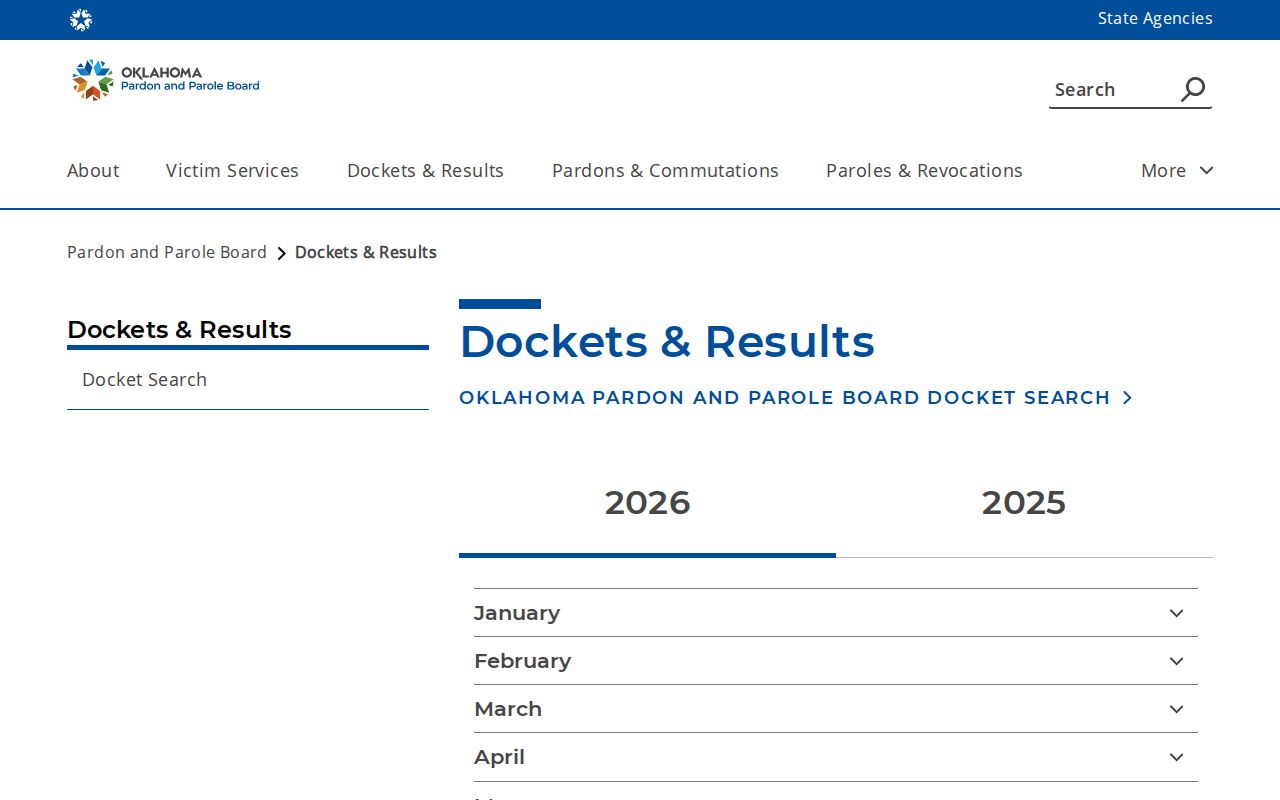
Search the PDFs by ODOC number, verify the legend, and then return to ODOC or VINE for the later custody movement.
Eligibility, a docket appearance, a favorable vote, release to parole, and discharge are five milestones. For crimes in different date cohorts, 57 O.S. section 332.7 uses different general parole-eligibility fractions and limits. Section 13.1 can impose its separate 85-percent rule. These rules should never be converted into a release date without the full sentence inputs.
ODOC Release Document Lifecycle
ODOC policy identifies a Certificate of Release and a Notice of Inmate Status Change. These named records explain why a lookup screenshot and formal proof do different work. The public profile is a current-facing view assembled from agency data. The certificate or status notice records an agency action. After jurisdiction terminates, the file routes toward Closed Records under ODOC policy.
A narrow request is more useful than asking for an undefined full inmate file. Supply the person's full name, aliases, ODOC number, lawful date of birth when available, conviction county and case, and a date range. Ask for the existing Certificate of Release, Notice of Inmate Status Change, discharge record, status history, or public sentence and release-computation material that answers the question.
Match the document to the question. A Certificate of Release can address the agency's recorded physical release. A status-change notice can document a change within the correctional record. A discharge certificate concerns the end-of-jurisdiction process. A sentence-computation record can explain inputs without proving the actual time a person crossed the gate. Asking for one named item reduces confusion and needless redaction review.
ODOC sentence administration also sends disposition information through internal record channels. That process explains why a live profile can change after a court order or institutional action. It does not turn the public portal into a certified record. When two official sources appear inconsistent, give ODOC both access dates and exact labels, and ask which existing record controls the requested event.
Request ODOC Release Records
Use ODOC's Closed Records request form for a terminated-jurisdiction file and the general Open Records form for other agency records. ODOC Legal Services provides the agency route. Identify whether inspection or an electronic copy is preferred, ask for a cost estimate, and expect confidential parts to be redacted or withheld. The Oklahoma Open Records Act does not require ODOC to create a new custom analysis.
Under 51 O.S. section 24A.5, ordinary copies are generally capped at 25 cents per page and certified copies at one dollar per page. Statutorily described search fees can apply in certain commercial or clearly disruptive requests. No sourced statewide deadline guarantees a response on a set day. A concise request tied to named existing documents is easier to process and verify.
The ODOC Closed Records form is the designated route for a former offender's terminated-jurisdiction file.
ODOC Versus County Release
ODOC offender search coverage is for Oklahoma state corrections records. A person released from a county jail on bond, after time served, after dismissal, or by local court order may never appear in ODOC. The county sheriff, detention authority, jail trust, or municipal police custodian keeps that local movement record. Choose the last actual custodian, not simply the county where the case began.
The Oklahoma County Directory routes local cases, while the statewide Facility Directory distinguishes county, municipal, ODOC, federal, ICE-linked, tribal, juvenile, and closed locations. A notation such as released to ODOC or released to ICE means transfer to another custodian. It does not prove community release.
| Question | ODOC record | County record |
|---|---|---|
| Who is covered? | State prisoners and people in ODOC supervision or history | People booked or held by that local custodian |
| What proves movement? | Agency status record or named release document | Booking/release sheet or jail-register entry |
| What does parole mean? | Release from prison with supervision continuing | Not a county-jail release type by itself |
| Where is the court order? | With the appropriate court clerk, separate from the physical custody record | |
Facility ownership can be more important than geography. A federal institution in Oklahoma reports through BOP. An ICE-linked placement uses ICE custody channels for immigration detention. A tribal detention record belongs to the sovereign authority that maintains it. Even within one county, the sheriff, a jail trust, municipal police, ODOC, and federal agencies may hold separate records for the same person at different times.
Use the release disposition to connect those stages. If the county record says transferred to ODOC, search the ODOC number and state profile next. If ODOC records an INS detainer or another-custody exit, check the named receiving authority. The sending entry proves that one custodian's custody ended, not that all custody ended.
ODOC Search Retention Limits
A former offender may remain searchable, but ODOC does not publish a fixed guarantee for every discharged public profile. Public fields can vary by record and status. A blank search can also result from spelling, aliases, an incorrect identity, or a record that now belongs in Closed Records. Repeat the search with the ODOC number before drawing a conclusion.
Discharge also does not erase the related court case. Oklahoma expungement under 22 O.S. sections 18 and 19 requires eligibility and a court order. Until an authorized seal or expungement changes access, the ODOC record, court docket, and county booking record may have different lawful retention and display paths. Each source should be described on its own terms.
Identity checks remain essential in old records. An ODOC number is stronger than a name alone, while a conviction county and court case help tie the agency record to its legal source. Photograph and age details can narrow a match but may be dated. If a profile conflicts with a certified court order or formal ODOC response, preserve both and seek clarification from the office that issued the correctional record.
A roster miss is the start of a fallback, not the end of a search. Try the agency number, review aliases, confirm that the person was in Oklahoma state custody, and use Closed Records when jurisdiction has terminated. For a county booking, return to the local custodian. For a federal case, use BOP. Those boundaries keep ODOC released-inmate research accurate.